

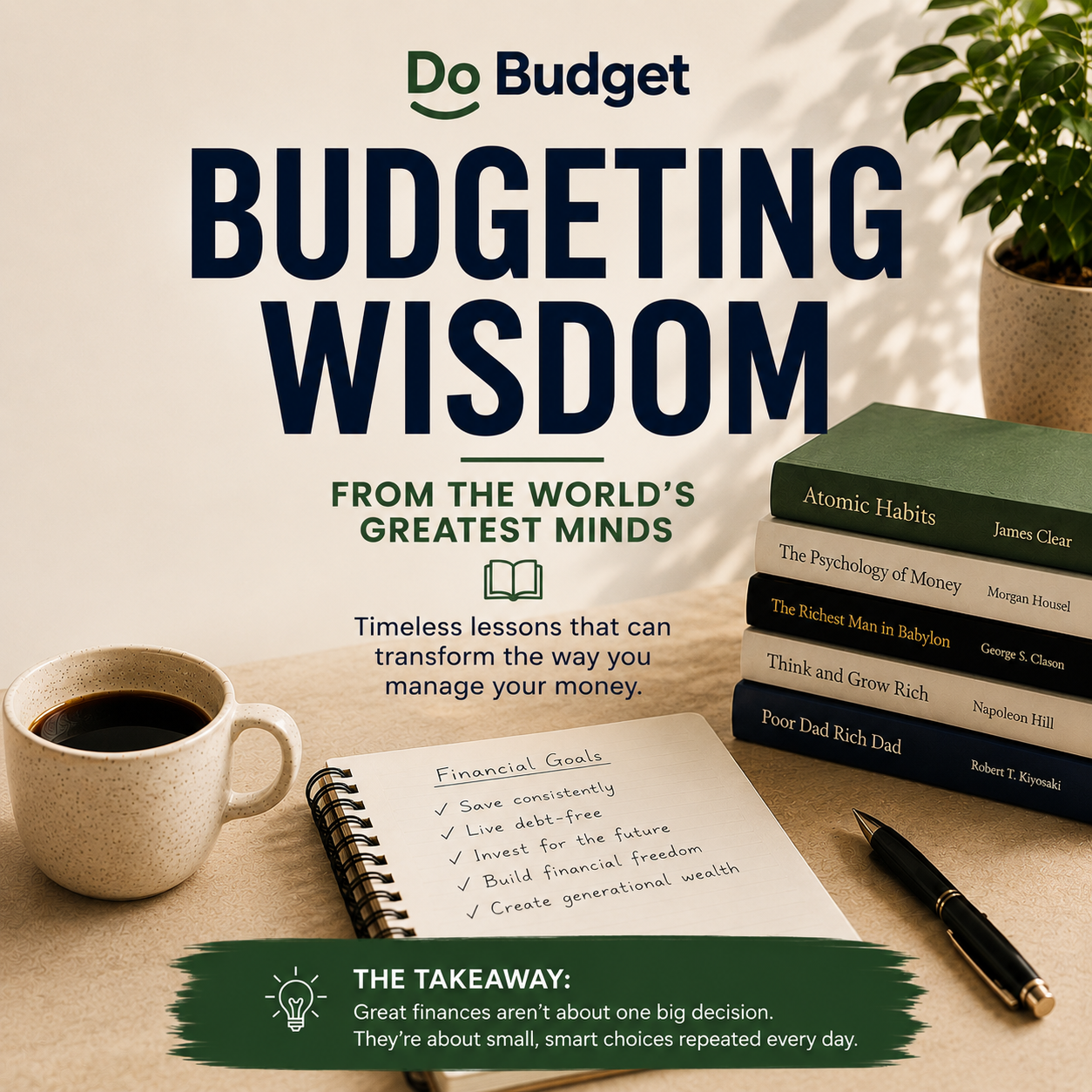
The Budgeting Wisdom Hidden in the World’s Most Influential Minds
Walk into any bookstore and you’ll find shelves lined with books promising financial freedom. Some focus on investing. Others teach strategies for getting out of debt or building wealth. Yet some of the most valuable lessons about budgeting aren’t found in personal finance books at all.
They’re hidden inside books about habits, psychology, leadership, business, and success.
Writers like James Clear, Morgan Housel, George S. Clason, and entrepreneurs such as Warren Buffett and Steve Jobs weren’t trying to teach people how to build a monthly budget. Still, the principles they shared have become some of the strongest foundations for financial success.
When you look closely, they all point to the same truth. Building wealth isn’t about making one brilliant decision. It’s about making hundreds of good ones, over and over again.
That’s exactly what budgeting is.
Budgeting Is More Than Numbers
Many people think of a budget as a list of rules that limits what they can buy. They imagine spreadsheets, calculators, and constantly telling themselves “no.”
The reality couldn’t be more different.
A budget is simply a plan for your money. It gives every dollar a purpose before it’s spent. Instead of wondering where your paycheck disappeared, you already know where it’s going.
The world’s greatest thinkers understood that success always begins with intention. Money is no different.
James Clear: Systems Beat Motivation
In Atomic Habits, James Clear writes,
“You do not rise to the level of your goals. You fall to the level of your systems.”
It’s one of the most quoted lines in personal development, and it perfectly describes why so many budgets fail.
Most people don’t fail because they don’t want to save money. They fail because they’re relying on motivation.
Motivation is temporary.
A good system lasts.
Someone who automatically transfers money into savings every payday doesn’t need to remember to save. Someone who reviews their spending every Sunday doesn’t wait until the end of the month to discover they overspent.
Successful budgeting isn’t about trying harder.
It’s about making good financial habits automatic.
Morgan Housel: The Small Decisions Matter Most
Morgan Housel’s bestselling book The Psychology of Money reminds us that financial success is driven far more by behavior than intelligence.
Most people aren’t held back because they don’t understand investing.
They’re held back by everyday decisions.
An extra streaming subscription.
Ordering takeout a few nights each week.
Buying things simply because they’re on sale.
None of these purchases seem significant by themselves, but over months and years they quietly shape our financial future.
Budgeting doesn’t stop you from spending.
It helps you become aware of where your money is actually going, allowing you to decide whether those purchases still align with your priorities.
Warren Buffett: Pay Yourself First
Warren Buffett has built one of the greatest investment records in history, yet one of his simplest pieces of advice remains one of the most powerful.
“Do not save what is left after spending, but spend what is left after saving.”
Many people treat savings as an afterthought.
Bills get paid.
Shopping happens.
Entertainment comes first.
Whatever remains gets saved, if anything remains at all.
Buffett suggests reversing that process.
By moving savings to the beginning of the month instead of the end, you’re making your future self a priority. Even small amounts, saved consistently, can grow into something remarkable over time.
George S. Clason: Ancient Advice That Still Works
Nearly a century before budgeting apps existed, George S. Clason shared a timeless lesson in The Richest Man in Babylon.
Pay yourself first.
The advice has survived generations because human nature hasn’t changed.
People will always find reasons to spend today instead of saving for tomorrow. Building wealth isn’t about waiting until you have extra money.
It’s about deciding that saving deserves a place in your monthly budget before anything else.
Some financial advice becomes outdated.
This principle never has.
Steve Jobs: The Power of Saying No
Steve Jobs once said that focus is about saying no.
Although he was speaking about innovation, the lesson applies just as well to personal finance.
Every dollar has only one destination.
Buying one thing often means giving up another opportunity.
That doesn’t mean every purchase is wrong.
It simply means every purchase is a choice.
Budgeting helps make those choices intentional instead of accidental.
Ramit Sethi: Spend on What You Love
Personal finance author Ramit Sethi offers one of the healthiest perspectives on money.
“Spend extravagantly on the things you love, and cut costs mercilessly on the things you don’t.”
That’s what budgeting should feel like.
A good budget doesn’t remove happiness.
It creates room for it.
If travel brings you joy, plan for it.
If spending time with family matters most, prioritize those experiences.
At the same time, don’t be afraid to reduce spending on subscriptions, impulse purchases, or habits that no longer add value.
Budgeting isn’t about spending less.
It’s about spending intentionally.
One Lesson Connects Them All
James Clear teaches systems.
Morgan Housel teaches psychology.
Warren Buffett teaches patience.
George S. Clason teaches consistency.
Steve Jobs teaches focus.
Ramit Sethi teaches intentional spending.
Different people.
Different careers.
Different generations.
Yet every one of them arrives at the same conclusion.
Success isn’t created overnight.
It’s built one decision at a time.
Your financial future is shaped in exactly the same way.
Every grocery trip.
Every savings deposit.
Every impulse purchase you avoid.
Every month you stay consistent.
Those small decisions become your financial story.
The Best Time to Start Is Today
You don’t need to become an investing expert before creating a budget.
You don’t need a higher salary.
You don’t need the perfect financial plan.
You simply need to begin paying attention.
Track where your money goes.
Review your spending regularly.
Improve one habit at a time.
That’s how lasting financial progress is built.
If you’re looking for a simple way to put these lessons into practice, Do Budget helps you track your spending, organize your finances, and build better money habits with confidence.
Because budgeting was never about restricting your life.
It’s about giving every dollar a purpose.
Less money stress. More money progress.